Established in 1907

Shri Lal Mahal in News

Basmati Rice – Wholesale Price & Mandi Rate Guide

Basmati Rice – Wholesale Price & Mandi Rate Guide

Looking at the features of such long grains, their fragrance, and the pen-cooled elite, one can perhaps consider that Basmati rice is the mainstay of many homes and, to a large extent, it forms part of many global cuisines. For a trader, retailer, or consumer, it is imperative to understand the wholesale and mandi prices of Basmati rice because each will inform the decision-making process. What drives these prices, the trends in the market as far as Basmati rice is concerned, and some tips for buying into the wholesale and mandi markets, comprise a few of the topics we will be covering in this article.

Factors that Determine Basmati Rice Rates Newspaper

These are few reasons why the wholesale and mandi rate of Basmati rice will differ.

Type of Basmati Rice: Different varieties exist under the heading of Basmati, which includes the 1121, Pusa, Traditional Basmati, and 1509. Usually, premium varieties such as 1121 Basmati have a price that is more than the others because of its superior quality of grain length and aroma.

Harvest Season: In India, Basmati rice is harvested between October and December. Generally, the price touches the lowest level during this harvest period because the available supply is abundant, and thus it increases in the off-season months.

Geographical Location: Mandi rates differ from one state to others like Punjab, Haryana, Uttar Pradesh, and Uttarakhand in which Basmati is highly grown. Transport costs and local demands are also affecting such difference. 

Quality and Processing: Quality and processing, like grain length, purity, moisture content, and steam, raw, or parboiled type, will define the price of Basmati rice. High-quality, well-processed rice attract premium costs.

Export Demand: India is a global Basmati rice exporter to Saudi Arabia, Iran, and the UAE. Strong export demand boosts domestic prices.

Government Policies: Apart from this, market rates can also be affected from time to time because of Minimum Support Prices (MSP), export tariffs, and subsidies.

Changing Market Dynamics: Wholesale prices will also be affected by fluctuations in supply chains, fuel prices, and trader margins

Basmati Rice Rates

Present Wholesale Prices And Mandi Rates (April 2025)

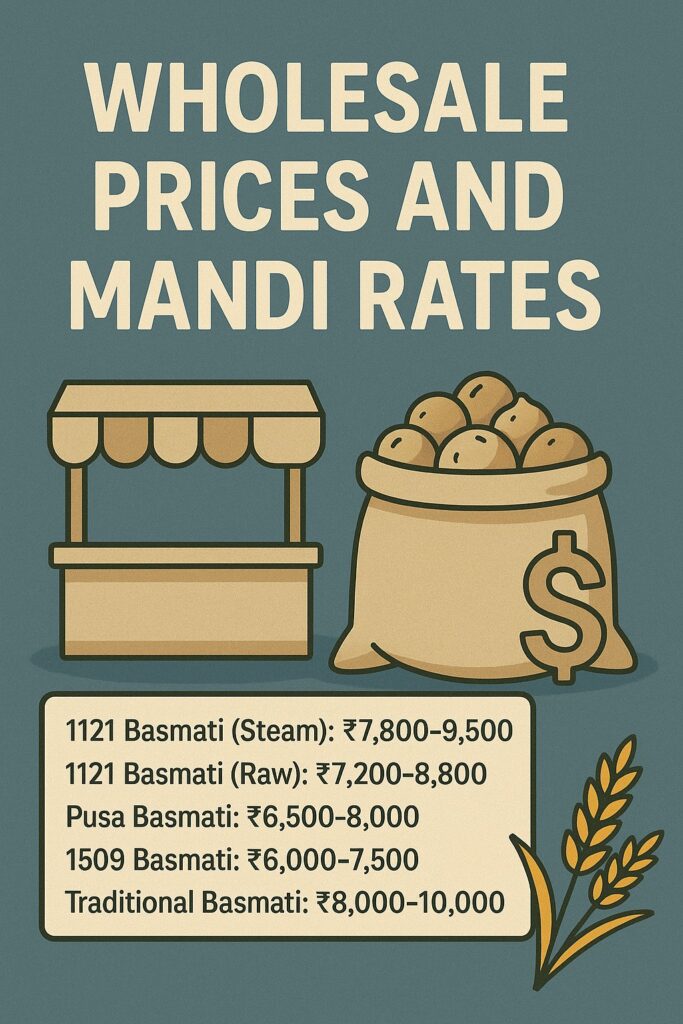
The Basmati rice price also depend upon variety, quality, and region within India in April 2025. The indicative range of wholesale and mandi prices of some selected Basmati varieties is given below (price per quintal i.e.,100 kg):

1121 Basmati (Steam): ₹7,800-9,500
It is famed for its extra-long grain and premium quality. The rice is most cherished in the domestic and export markets.

1121 Basmati (Raw): ₹7,200-8,800
Less processed compared to steam, raw 1121 is preferred for its natural taste.

Pusa Basmati: ₹6,500-8,000
A high-yielding variety with a good aroma, suitable for bulk purchasing.

1509 Basmati: ₹6,000-7,500
It is an earlier-maturing and cost-effective variety that is frequently bought in a budget.

Traditional Basmati: ₹8,000-10,000
This variety is cherished for its original taste and mostly used in premium preparations.

Note: These are indicative prices based on prices of major mandis like Karnal (Haryana), while rates are also based on market trends of Amritsar (Punjab) and Bareilly (Uttar Pradesh). Rates are, however, subject to some small variations depending on the mandi where sale happens, quality of the produce, and terms of trade.

Basmati Rice - Wholesale Price & Mandi Rate Guide

Mandi Rates-checking Procedure

What are the best ways to get information about mandi rates for Basmati rice?

e-NAM Portal: The National Agriculture Market (e-NAM) provides real-time information on mandi prices across the country. Prices can be filtered by state, commodity, and variety.

Local Mandis: Daily price updates can be obtained from the big mandis, such as Karnal, Taraori, and Amritsar, either by personal visit or through phone calls.

Agmarknet: This is the government website providing detailed prices of agricultural commodities including Basmati rice.

Trader Networks: You may find WhatsApp groups and online forums of rice traders, which will help you get hold of all current rate updates and trends.

Market Apps: Market-related applications Kisan Suvidha and AgriApp provide price alerts and connect users with agents operating in the respective mandis.

Secrets to Buying Basmati Rice Wholesale

Price Comparisons at Mandis: Prices can vary significantly between mandis within Punjab, Haryana, and Uttar Pradesh. For example, Karnal has good price levels for 1121 Basmati.

Check for Quality: Always check for grain length, aroma, and moisture content of the rice. Sample it before buying in bulk.

Remember to Negotiate: Better relationships with reliable suppliers translate into better prices, especially with large orders.

Know the Processing Type: Choose raw, steam, or parboiled basmati according to your clientele or end use.

Export Trends: If the demand in exports goes up, the domestic prices may also go up too. One must consider the global market news.

Ensure Storage: Prices tend to fall post-harvest on Basmati rice. Buy and store it in large quantities to reduce costs.

Problems in Basmati Rice Trade

There will always be some problems that Basmati buyers and sellers face:

Price Fluctuation: The price changes very quickly with the change of export policy or weather conditions.

Adulteration: Some suppliers mix inferior varieties of rice with Basmati, which spoils credibility and pricing.

Increased logistics cost: Higher fuel prices and transportation costs increase the final price to buyers.

Regulations Altered: Any export bans or changes in MSP can throw the market totally out of gear.

Conclusion

With the Basmati rice still one of the high-value commodities in the import and local markets, its price at wholesale remains determined by quality, market demands, and regional factors, including mandi rates. Keeping oneself updated about the current rates, peeking into the dynamics of the market, and developing good rapport with suppliers are certain factors that determine how good a buyer is. Wholesalers dealing in retailing for local sale or traders on the lookout for prospective exports need to keep abreast with the Basmati rice business to sustain profit potential.

Related Posts

Buying Rice Here’s What Matters Beyond Price
Blogs
admin

Buying Rice? Here’s What Matters Beyond Price

Buying Rice is one of those intricate tasks which requires proper knowledge of rice, its quality and aroma. Therefore, it does not wholly depend on price. There is a lot about buying rice beyond rice. Today, we will discuss this intricate task and find out some suggestions for buying rice beyond price.
Introduction
Most shoppers focus on price, but buying the cheapest rice isn’t always the smartest choice. Rice quality affects not only taste and texture, but also how it cooks, how nutritious it is, and how satisfying it feels in a meal. Different rice types vary in fibre, aroma, grain length, and cooking behaviour. These are the factors that can turn a dish from bland to exceptional. Understanding these differences helps you choose rice that fits your health needs, cooking style, and cultural dishes, rather than just your budget.

Read More »
The Struggles Of Cooking Rice Why It Breaks, Sticks, and Tests Our Patience
Blogs
admin

The Struggles Of Cooking Rice: Why It Breaks, Sticks, and Tests Our Patience

Rice is the primary staple food in the world and is generally found in every kitchen. Moreover, it is often considered a basic dish that requires little skill to prepare. Since it appears so simple, cooking rice is usually considered normal, until it goes wrong. However, it is pretty normal that several kitchens have experienced a little disappointment when opening a pot to find rice that is either broken, mushy or clumped together instead of light and fluffy. Surprisingly, despite using the same ingredients and methods, the results can be frustratingly inconsistent, making rice one of the most deceptively difficult foods to master. This struggle raises an important question: if rice is such a fundamental food, why does it so often break or stick together during cooking?

Read More »
GI Tagged Rice Varieties And India’s Cultural Heritage
Blogs
admin

GI Tagged Rice Varieties And India’s Cultural Heritage: A Journey Across The Regions

It’s a sign used for products that originate from a particular location, having a distinct nature and a unique quality, reputation or characteristic essentially attributable to that origin. Moreover, it acts as a certification ensuring authenticity, quality and preventing misuse by unauthorised users. Hence, safeguarding traditional Knowledge, boosting local economies and preserving cultural heritage. Notably, the GI tag is granted under the Geographical Indications of Goods (registration and protection) Act 1999, in India. It remains valid for 10 years, but it has to be renewed. Its failure could cause the lapse of registration and thus leave the product unprotected against misuse or imitation.

Read More »